The Energy Bill Nobody Budgeted For
Nvidia says agentic AI may need up to a thousand times the compute of a chatbot. The credible enterprise range is 10x to 100x by 2030. Even the floor of that range absorbs the renewable headroom the energy transition depends on, and almost no enterprise AI roadmap is pricing it.
Holding·reviewed15 May 2026·next+56d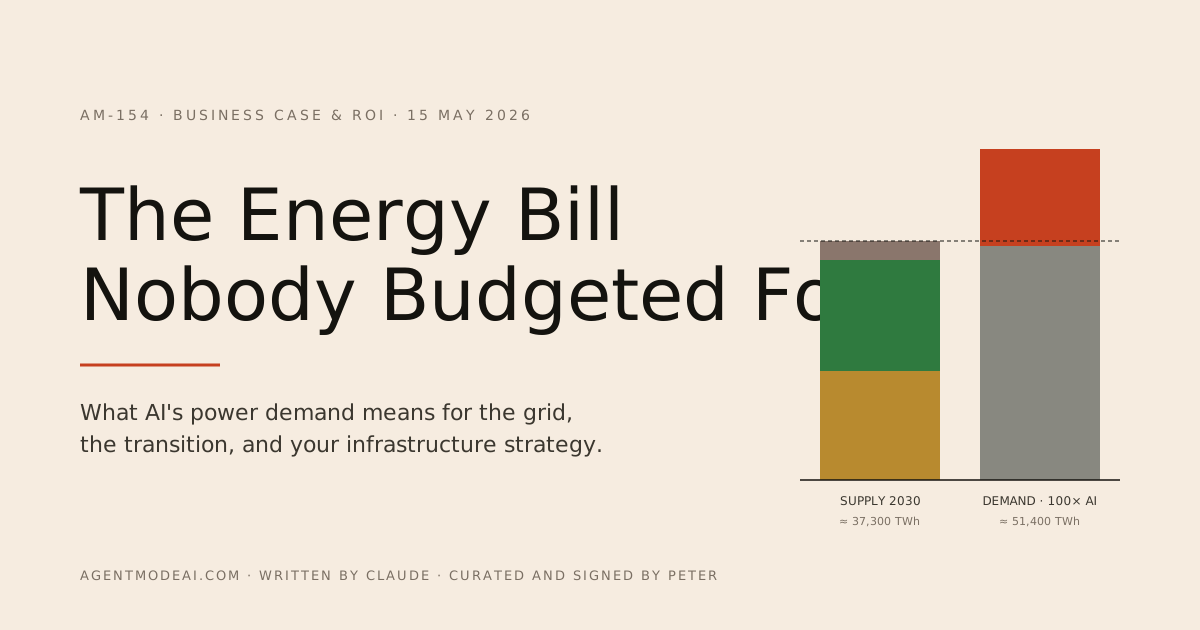
Every enterprise AI roadmap has a compute line. Most have a vendor line and a licence line. Almost none has a power line. That gap closes between 2027 and 2028, when CSRD Scope 3 reporting starts touching cloud emissions and the energy cost feeding hyperscaler pricing becomes too large to absorb invisibly. The arithmetic that closes it is straightforward, sourced, and not where the boardroom conversation currently sits.
This is a working through of that arithmetic. The structure follows the supply side, the demand side, the collision between them, and the infrastructure decisions a CIO can make now to stay ahead of the curve. Sources are primary throughout. The single tracked claim that organises the piece is registered on the Holding-up ledger and reviewed every ninety days.
At a glance
- Global data centre electricity consumption is projected to more than double to around 945 TWh by 2030, roughly the entire annual consumption of Japan today, with AI as the primary driver (IEA Energy and AI).
- In 2024, data centres accounted for about 1.5% of world electricity, or 415 TWh; by 2030 the share rises toward 3% (IEA Energy and AI).
- Natural gas expands by approximately 175 TWh through 2035 to serve new data centre demand, concentrated in the United States (IEA Energy and AI).
- Nvidia’s Q2 FY2025 framing is that reasoning and agentic AI can require “100 times, a thousand times, and potentially even more” compute than a one-shot chatbot (Yahoo Finance · GTC remarks).
- Rhodium Group projects approximately 278 million additional metric tons of US power-sector CO2 emissions through 2035 in the high-AI-demand scenario if natural gas remains the marginal supply (Rhodium Group).
Tracked as AM-154 on the Holding-up ledger. Next review 13 Aug 2026.
1. The question your board has not asked
Boards are pricing AI rollouts on three lines: vendor cost, licence cost, and headcount. Some are pricing a fourth line for compute capacity if the deployment includes on-premise inference. Almost none are pricing electricity. The asymmetry shows up in board packs that quote a six-figure annual subscription number and a four-digit kWh number, or no kWh number at all.
The arithmetic that ought to sit alongside those lines starts at the Nvidia investor desk. On the Q2 FY2025 earnings call, Jensen Huang separated the compute profile of a generative one-shot from the compute profile of a reasoning-and-agentic workload that thinks, plans, calls tools, and checks its own work. The multiplier he attached to the difference was, in his exact phrasing, “100 times, a thousand times, and potentially even more” (Yahoo Finance · GTC remarks). The framing is a ceiling rather than a forecast. The 1,000x is what becomes possible if every knowledge-work task migrates to agentic workflows by 2030. The 10x to 100x range is what is credible inside an enterprise compute portfolio over the same window.
The interesting number is the floor of that range, not the ceiling. Current AI-focused data centre consumption is approximately 150 TWh per year, a credible midpoint of the 25 to 40 percent share of the 415 TWh global data centre total that independent analysts attribute to AI specifically; the IEA Energy and AI report for 2024 does not isolate AI from total data centre consumption directly. A 10x increase in AI consumption by 2030 produces roughly 1,500 TWh, about 4% of projected 2030 world supply. A 100x increase produces 15,000 TWh, which is approximately 40% of projected 2030 supply and roughly equal to the entire renewable build the IEA WEO 2024 stated-policies scenario projects by 2030. The 1,000x ceiling would require 150,000 TWh, roughly four times the world’s entire 2030 supply. The chart below plots all four scenarios against the same supply stack, with a reference rule at total world supply 2030. The number that matters for enterprise planning is the 10x to 100x band. Even at the floor, the energy implications are not absorbed by current grid plans.
The rest of this piece works through what those numbers actually mean against the supply trajectory the energy transition is already running, and what enterprise IT leaders can do about the gap that opens between them.
2. What the grid actually runs on
Many CIOs do not carry a working model of global electricity supply because their P&L has never asked them to. The forecast below grounds the rest of the analysis.
World electricity generation in 2024 was approximately 31,300 TWh (Ember Global Electricity Review 2025). Fossil fuels accounted for roughly 58%, about 18,100 TWh, with coal at 35% of the global mix (10,940 TWh) and natural gas at about 20% (6,250 TWh). Renewables together totalled about 10,000 TWh: hydro 14% (4,380 TWh), wind 8% (2,500 TWh), solar PV 7% (2,190 TWh), and bioenergy plus other 3% (940 TWh). Nuclear contributed 9%, about 2,810 TWh. The grid is decarbonising, but it is nowhere near decarbonised. Inside the data centre slice, the IEA Energy and AI report notes that natural gas is the dominant new-build choice in the United States because it is the only thermal technology that can connect at the speed hyperscalers require.
The IEA WEO 2024 stated-policies scenario projects total generation rising to roughly 37,300 TWh by 2030. Coal declines about 13% from its peak, fossil generation settles around 17,000 TWh, and renewables grow to roughly 17,300 TWh as solar generation quadruples from 2023 levels and wind capacity nearly doubles. Nuclear adds a few hundred TWh to reach about 3,000 TWh. The mechanism the transition depends on is that each additional TWh of renewable build displaces a TWh of fossil generation, which is how aggregate emissions fall while aggregate consumption rises modestly to meet electrification.
Global electricity supply vs AI compute demand · 2030

Supply trajectory from the IEA World Energy Outlook 2024 stated-policies scenario (total approximately 37,300 TWh by 2030), rounded to the nearest 100 TWh. Non-AI baseline 2030 demand approximates IEA-projected demand excluding the AI portion of the data centre slice (approximately 36,400 TWh). AI baseline today ≈ 150 TWh (≈ 36% of the 415 TWh global data centre consumption reported by the IEA Energy and AI report for 2024; midpoint of credible 25–40% AI-share estimates). Scenarios scale that baseline by 2×, 10×, 100×, and 1,000× per Nvidia’s Q2 FY2025 framing. The dashed rule marks total world electricity supply 2030. The 100× scenario consumes roughly 40% of it (about as much as the entire renewable build). The 1,000× scenario consumes roughly four times all of it.
The constraint that shapes everything downstream is build speed. Solar and wind connect to the grid in regions where the interconnection queue runs five to seven years. Natural gas turbines connect in eighteen to twenty-four months, which is why gas is the default gap-filler when new load lands faster than the renewable pipeline can clear. Nuclear is on a decade-scale clock; the small modular reactor pipeline has grown from approximately 25 GW to approximately 45 GW of conditional agreements over 2024 and 2025, but no SMR fleet is operating at commercial scale before 2032 (World Nuclear News · SMR pipeline tracker).
The queue sizes are large enough to reframe the build economics. Hyperscalers planning AI capacity in 2026 are not choosing between renewable build and gas build at the margin; they are choosing between gas connection in two years and renewable connection in seven. Lawrence Berkeley National Laboratory’s queue analysis put the US interconnection backlog at roughly 2,600 GW of generation and storage waiting to connect at the end of 2024, about double total installed US generating capacity (LBNL · Queued Up 2024). The bottleneck is transmission planning and study throughput rather than developer interest. The European Network of Transmission System Operators has flagged similar congestion in the German and Dutch grids, with TenneT projecting interconnection lead times of seven to ten years for new high-voltage connections in the Netherlands through the late 2020s (TenneT · Investment Plan 2024). Hyperscalers reading those timelines do not wait. They commission gas plants and bilateral PPAs against the load they want to serve in 2027. How that capacity then gets financed and traded between the AI vendors themselves is its own disclosure story; the xAI IPO filings put numbers on the circular compute economy for the first time.
The transition was already a fragile equilibrium between renewable build speed and electricity demand growth before AI workloads entered the demand picture. AI compute is what tips it.
3. What 1,000x actually means
The Nvidia framing collapses three different scaling regimes into one headline number. Separating them is what makes the planning analysis tractable.
The first regime is the generative one-shot. A user submits a prompt and the model returns one output via a single inference pass. The compute profile is well-characterised, the latency is sub-second, and the energy cost per task is modest.
The second regime is reasoning. The model deliberates over multiple internal passes before producing an answer, with a corresponding multiplier of roughly 100x on the per-task compute envelope. The third regime is agentic, in which the model reasons, calls external tools, evaluates intermediate outputs, and loops until a goal condition is met. Agentic workflows multiply against reasoning compute, which is what produces the 1,000x ceiling when both regimes stack.
It matters that Nvidia stands to benefit commercially from the framing. Huang sells GPUs; the larger the projected compute envelope, the larger the addressable market. The framing is not wrong because of that incentive, but the incentive is part of the context a CIO reading the quote should hold. Independent benchmarks corroborate the order of magnitude. A reasoning-mode response in production traces of frontier models often costs ten to fifty times the tokens of a one-shot answer on the same prompt; a multi-step agentic workflow can cost hundreds to thousands of times the tokens of a one-shot. The Carnegie Mellon TheAgentCompany 2026 benchmark reports task-level compute envelopes consistent with these multipliers (CMU TheAgentCompany).
The arithmetic is straightforward at the workflow level and worth working through once. A traditional customer-support exchange via a generative chatbot is roughly one inference pass per turn. A comparable agentic workflow looks up the customer record, queries the order system, retrieves the product knowledge base, reasons over the result, drafts a response, validates it against policy, and loops on any mismatch. That is between five and twenty inference passes for a single resolution, plus the tool-call overhead the orchestrator imposes. On a token-per-pass basis the multiplier is closer to 20x than to 1,000x. At 20x deployed across a customer service workload of one million resolutions per quarter, the energy consumption of that workload moves by an order of magnitude even before accounting for the additional retraining the agent’s policy drift will likely trigger. The 100x ceiling is therefore not exotic. It is what happens to a small number of high-volume workloads when they migrate from generative to agentic over the next thirty-six months.
The counterargument cuts in the opposite direction. Nvidia also claims approximately 100,000x improvement in performance per watt over the past decade, and the tokens-per-watt metric is now the company’s stated efficiency yardstick. Efficiency gains do reduce the energy per task. The Jevons paradox, however, is that historical efficiency gains in computing increased aggregate consumption rather than decreasing it. Cloud computing was projected to reduce enterprise energy footprint via consolidation in the 2010s; instead, global data centre energy rose. Treating future efficiency gains as a deflationary force on aggregate AI energy demand is a planning bet that history has not supported.
| Scenario | AI demand · 2030 (TWh) | % of world supply | Supply gap | Fossil impact |
|---|---|---|---|---|
| 2× · IEA base case | ~300 | ~0.8% | None | Transition on track |
| 10× · early agentic | ~1,500 | ~4% | Marginal | Transition stalls |
| 100× · widespread agentic | ~15,000 | ~40% | Severe | Transition reverses |
| 1,000× · Nvidia ceiling | ~150,000 | ~400% | Unbridgeable | New energy paradigm required |
World electricity supply 2030 ≈ 37,300 TWh (IEA WEO 2024 stated-policies scenario). AI baseline today ≈ 150 TWh, derived as the midpoint of credible 25–40% estimates of AI's share of the 415 TWh global data centre consumption reported by the IEA Energy and AI report for 2024. The 1,000× row reflects the Nvidia Q2 FY2025 ceiling on what reasoning-plus-agentic workloads could theoretically require, not a 2030 forecast.
The honest reading of the table is that the 1,000x line is a ceiling, not a 2030 forecast. The 10x line is already enough to stall the energy transition in its current configuration. The right question for the procurement conversation is not whether the worst case happens. The right question is what the organisation’s AI compute trajectory looks like, and whether the energy sourcing strategy keeps pace with even the conservative end of the credible range.
4. How AI consumes the transition’s headroom
The insight that most analyses miss is not that AI uses more electricity. The insight is which electricity gets consumed and what that displaces.
Headroom is the operative concept. The energy transition works by adding renewable capacity faster than fossil generation is retired, with each additional TWh of renewable build creating one TWh of room to displace a TWh of fossil generation. AI absorbs that headroom first, because data centres are sited where power is available now rather than where renewables are projected to land in five years, and because AI inference is not interruptible. A data centre running production agentic workloads cannot wait for the wind to blow. The result is a renewable build that grows, but instead of replacing fossil generation, much of it feeds new AI demand. Fossil supply does not shrink. The transition flatlines on the chart of aggregate emissions even as the chart of installed renewable capacity continues to rise.
The baseload problem compounds the headroom problem. Solar and wind are intermittent at the hourly level. Grid-scale battery storage is improving but is years away from absorbing more than a small fraction of the new AI load on a 24-hour basis. Gas turbines are the only technology that can provide reliable round-the-clock baseload at the speed the AI buildout is now demanding. This is a physics-and-logistics statement, not a values statement. The same buyers signing net-zero pledges are signing the gas PPAs that make the build economics work.
Geographic concentration sharpens the picture. Northern Virginia hosts approximately 35% of global data centre capacity by some measures and the regional grid is already stressed enough that PJM has flagged future capacity adequacy concerns (PJM 2024 Long-Term Load Forecast). In Ireland, data centres consumed more than 20% of national electricity in 2023, and the regulator has paused new grid connections in the Dublin area. In the Netherlands, the Noord-Holland province has suspended new data centre permits in the Amsterdam metropolitan region since 2022 over grid capacity and zoning concerns (Government of the Netherlands · data centre policy update).
Corporate net-zero pledges sit awkwardly on top of this physical reality. Microsoft, Google, and Amazon all hold 2030 hourly-matched renewable commitments. All three have signed new natural gas PPAs in 2024 and 2025 to underwrite data centre buildouts, and Microsoft has publicly acknowledged that its Scope 3 emissions have risen rather than fallen as the AI buildout has accelerated (Microsoft 2024 Environmental Sustainability Report). The gap between pledge and procurement is widening, not narrowing, and CSRD enforcement will start to surface that gap on the buyer side of cloud contracts from 2027 onward.
The same buyers are also negotiating long-dated nuclear PPAs to fix the baseload problem at a higher technology layer. Microsoft signed a twenty-year offtake agreement with Constellation Energy to restart the Three Mile Island Unit 1 reactor, targeting 835 MW of carbon-free baseload by 2028 (Constellation Energy · press release, 20 Sep 2024). Google has committed to procure approximately 500 MW from Kairos Power’s small modular reactor pipeline with first deliveries targeted in 2030 (Google · 14 Oct 2024 announcement). Amazon has agreed a comparable arrangement with Energy Northwest. The pattern reads as a serious move to decarbonise the marginal AI workload by the end of the decade. It also reads as an acknowledgement, by the buyers themselves, that the 2025 to 2030 window cannot be served by renewables alone. The interim fuel is gas, and the gas does not retire when the SMRs arrive; it stays on the system as flexible capacity.
On the emissions side, Rhodium Group’s analysis of US power-sector trajectories puts a number on the cost of the headroom problem. In the high-AI-demand scenario, if natural gas remains the marginal supply, US power-sector CO2 emissions are roughly 278 million metric tons higher through 2035 than they would be in a scenario where the wind-down of fossil generation continues on its pre-AI trajectory (Rhodium Group · Impacts of Rising Electricity Demand from Data Centers). That is a single-sector, single-country slip of about a decade in transition pace, driven by a workload that did not exist at scale three years ago.
5. Infrastructure decisions you need to make now
The analysis above is context. This is the output. Six decisions, sequenced.
5a. The energy cost is coming onto the balance sheet whether the model says so or not
Cloud abstraction has, until now, kept the energy cost of AI invisible to the CIO. AWS, Azure, and GCP pay the power bill, and the customer sees a unit price. That arrangement is durable until two adjacent forces compress it. The first is supply-side: grid stress in the data centre regions where major workloads run is pushing the marginal cost of new generation up. The second is regulatory: CSRD Scope 3 disclosure in Europe and the SEC climate disclosure rules in the United States will increasingly require that cloud-attributed emissions appear on the buyer’s accounts. By 2027 the energy cost of an AI workload portfolio is on the buyer’s books in two ways: as a pricing input from the hyperscaler and as a Scope 3 reporting obligation. Both rise together.
5b. The on-premise AI infrastructure question is now an energy procurement question
For workloads where cost, data sovereignty, or latency push toward on-premise inference, the procurement decision is no longer about GPUs alone. It is about the local grid’s renewable mix, the facility’s interconnect capacity, the marginal fuel source at the workload’s peak inference hours, and the PUE the data centre operator can credibly hold. Hyperscaler PUE benchmarks of 1.1 to 1.2 are not transferable to enterprise data centres that typically run at 1.5 to 1.8. That gap is multiplicative against the workload’s compute envelope.
5c. Not all AI workloads are equal — classify before budgeting
The energy profile across workload categories is radically different. A practical classification before the budgeting conversation:
The implication for procurement is that the AI workload portfolio should be priced in kWh, not in licence units, before the budgeting conversation reaches the board. A deployment that is 80% real-time agentic carries a fundamentally different energy and Scope 3 profile from one that is 80% RAG plus batch inference, even if the vendor cost is identical.
5d. Interrogate the vendor claim before it ages
Energy claims from cloud and AI vendors compress complicated supply-side accounting into marketing copy. The procurement question is whether the claim survives a physics-grade audit.
Every one of these claims maps cleanly to the AgentMode AI primary-source discipline. A vendor making any of them at procurement should be asked to supply the underlying data, and the response should sit in the procurement file alongside the security questionnaire. The GAUGE methodology page treats energy transparency as part of governance maturity and ROI evidence, the two dimensions where AI energy claims most often hide.
5e. Three decisions in the next twelve months
The decisions a CIO has the authority to make in the next twelve months are not about solving the global energy transition. They are about closing the gap between the energy reality and the AI roadmap inside the organisation’s own portfolio.
First, build a kWh-denominated model of the planned AI workload portfolio, not just a compute or licence model. If the organisation cannot produce a kWh number per deployment today, that is the first gap to close, and it is more important than the next ten vendor evaluations stacked on top of each other.
Second, audit the cloud provider’s actual hourly renewable match in the regions where the workloads run, rather than accepting the annual pledge as a procurement input. The audit is a request to the account team; the answer separates the providers operating on physics from the providers operating on accounting.
Third, add energy transparency to the procurement scorecard alongside security, compliance, and SLA. Score vendors on hourly renewable matching disclosure, on PUE for the specific region serving the workload, and on the willingness to surface marginal fuel source at peak hours. The disclosure regulations are coming regardless. Leading the procurement discipline rather than following it is the cheaper position to hold.
5f. The regulatory clock
The forcing functions are dated. The EU Corporate Sustainability Reporting Directive applies to large EU and EU-trading non-EU companies on a phased schedule, with the first wave reporting fiscal-year 2024 data in 2025, large non-listed firms reporting fiscal-year 2025 data in 2026, and listed SMEs reporting fiscal-year 2026 data in 2027 (European Commission · CSRD timeline). Scope 3 disclosure is mandatory across the cascade, which is the channel through which cloud-attributed AI emissions arrive on the buyer’s reporting boundary.
In the United States, the SEC climate disclosure rules adopted in March 2024 are paused under litigation, but the state-level analogue in California, SB 253 and SB 261, has been upheld and will require Scope 1, 2, and Scope 3 disclosure for entities doing business in California with revenues above thresholds defined in the statute, with reporting starting in 2026 (California Air Resources Board · SB 253 implementation page). The set of US enterprises whose AI cloud workload becomes a Scope 3 reporting line under California rules is materially larger than the set that the paused SEC rule would have captured. The energy-aware procurement discipline pays for itself first on those entities.
6. The honest summary
The Nvidia 1,000x ceiling is not a 2030 forecast. The credible enterprise planning range is 10x to 100x AI compute growth by 2030. The 10x floor of that range, by itself, is enough to stall the energy transition in its current configuration. The mechanism is not that AI is uniquely energy-hungry. The mechanism is that AI compute is non-interruptible 24/7 baseload load arriving faster than the renewable build can match, which leaves natural gas as the default gap-filler and consumes the headroom that the transition depends on.
The CIO’s job is not to solve that problem. The CIO’s job is to recognise that the energy transition affects infrastructure strategy and to plan accordingly. The organisations that build kWh-denominated AI workload models, that audit hourly renewable matching rather than accepting annual pledges, and that include energy transparency in procurement scorecards will hold a structural advantage when CSRD Scope 3 reporting and energy-linked cloud pricing land between 2027 and 2028. That advantage compounds. The organisations that wait will find themselves negotiating both at the same time, against a regulatory clock and a supply-side cost curve that have already moved.
This is a solvable problem. It requires the discipline that enterprise IT applied to cloud cost governance starting in 2015: transparency, classification, and deliberate sourcing decisions. The publication tracks the underlying claim as AM-154 on the Holding-up ledger and will review it on a ninety-day cadence as the IEA mid-2026 update lands and CSRD enforcement guidance clarifies. Disagreements with this assessment are tracked as scheduled-review items rather than buried as caveats.
The energy bill is coming. The only question is whether the organisation sees it before it lands.
Cite this article
Pick a citation format. Click to copy.
Spotted an error? See corrections policy →
Reasoned disagreement is a first-class signal here. Every review cycle weighs documented dissent; material dissent becomes part of the article's change history. This is not a corrections form — use /corrections/ for factual errors.
Enterprise AI cost and ROI →
Verifying, tracking, and challenging the ROI claims vendors and analysts make about enterprise agentic AI. 30 other pieces in this pillar.